Understand the claw.
Check the cost.
A good aim is only part of a claw-machine play. Learn what the controls do, how payout settings work, and what a prize might cost before you spend.
Source review: October 28, 2026.
How a prize crane works
You move the overhead carriage, lower the claw, and try to carry a prize to the chute. Elaut’s E-Claw MKII manual (2018) describes this sequence. A lift alone does not count: the prize must enter the chute.
Check the price and controls before playing. Look for a clear route to the chute. Stop when you reach your spending limit, even if a previous attempt almost succeeded.
Skill, chance, and payout settings
Do not assume “skill” and “chance” are universal menu names. Elaut’s E-Claw MKII manual (2018) documents automatic and manual claw adjustment, separate pickup and retaining power, and a payout regulator. Manual adjustment does not by itself establish that a machine is purely skill-based.
The manual’s “Product definition” menu calculates “i set perc.” from the operator’s merchandise cost and intended revenue per prize. Its documented range is 20%–50%. That percentage concerns merchandise cost against revenue, not the proportion of plays that win. The menu example uses a cost of 4 and revenue of 10 to show 40%.
Elaut’s E-Claw 2.0 manual (June 2026) also documents random pickup height and separate pickup and retain power. Aim involves player skill; these settings affect what happens after the grab. A video of one dropped prize cannot reveal the operator’s configuration.
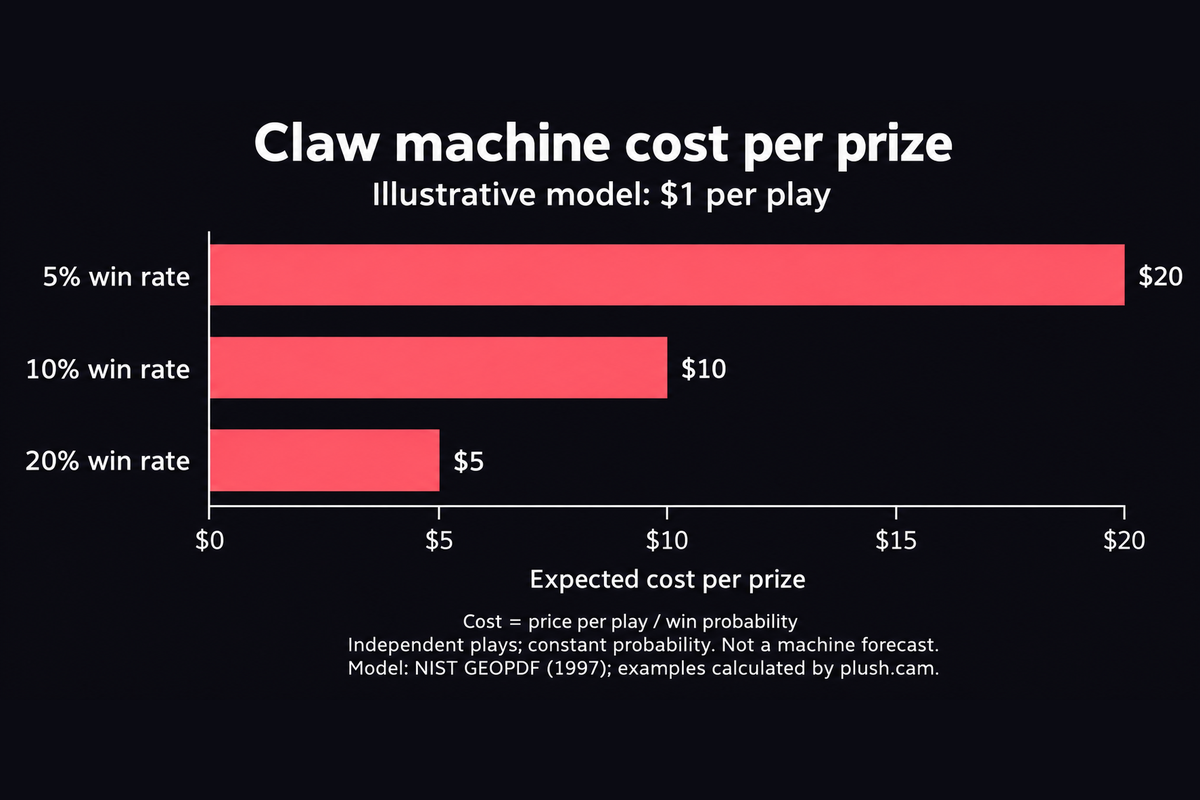
Claw machine cost per prize
Enter your play price, assumed win rate, and personal prize value in US dollars. Use the effective price after any credit bundle. The starting values are examples, not measured arcade odds.
- Expected cost per prize
- —
- Expected plays per prize
- —
- Break-even win rate
- —
Expected plays = 1 ÷ win probability.
Expected cost = play price ÷ win probability.
Break-even rate (%) = 100 × play price ÷ prize value.
Model: NIST, GEOPDF (1997). Its mean counts failures before success; adding the winning play gives the formula above. We assume independent plays with constant probability. Payout regulation and changing prize positions can violate that assumption. Results are averages, not a promise about your next play.
Compare cost with what the prize is worth to you. Break-even excludes delivery charges, travel, and resale costs. A required rate above 100% means prize value cannot cover even one paid play.
US rules depend on the state
The Washington Attorney General’s AGO 1987 No. 20 explains that a crane can involve gambling yet qualify as an approved amusement game. The distinction depends on statutory conditions, not the cabinet’s name.
Florida: The Florida Legislature’s 2026 Statutes, section 546.10, define amusement games around player skill without an inherent material element of chance. Type C covers enclosed claw devices that directly award merchandise. The law also restricts locations and wholesale prize cost. A claw cabinet alone does not establish compliance.
Washington: WAC 230-13-045, effective 2008 and checked in 2026, requires at least 20 seconds per operation. The claw must reach, pick up, and dispense every prize. Prizes must remain loose enough to retrieve. WAC 230-13-005 (2016) permits merchandise prizes and prohibits cash awards. Check the state regulator’s requirements before operating a machine.
Watch or stream a claw-machine cam
To watch, search your video platform for “claw machine live” and the arcade name. Check whether the video is live or a replay. Prefer a view that shows the controls, prize bed, and chute throughout a play. Treat highlight compilations as entertainment, not evidence of a typical win rate.
To stream your own machine, follow the OBS Project’s Quick Start Guide (2021):
- Run the Auto-Configuration Wizard.
- Add your camera through a Video Capture Source.
- Check the audio meters and selected devices.
- Make a test recording before you stream.
Frame the claw and chute together. Ask the venue before filming. Keep other visitors outside the frame. Label recorded footage as a replay. This page explains streaming; it does not operate a live camera or a remote-play service.